
Air masses are the foundation of weather systems. Their temperature, moisture content, and movement determine cloud types, precipitation, visibility, and storm potential. While air masses form with specific characteristics, they rarely stay unchanged. As they move away from their source regions, they are constantly modified by the surfaces and atmospheric conditions they encounter.
Understanding how air masses are classified—and how they evolve—provides critical insight into weather forecasting and atmospheric behavior.
How Air Masses Are Classified
Air masses are classified using three primary criteria: geographic origin, moisture content, and thermodynamic characteristics.
Geographic Origin
Air masses are first identified by the latitude of their source region:
Arctic (A) – Extremely cold air forming near the poles Polar (P) – Cold air forming in mid-to-high latitudes Tropical (T) – Warm air forming in low latitudes Equatorial (E) – Very warm, moisture-rich air near the equator Superior (S) – A warm air mass found primarily aloft over the southwestern United States

Each of these origins gives the air mass its initial temperature characteristics.
Moisture Content
Air masses are further classified based on whether they form over land or water:
Maritime (m) – Moist air formed over oceans Continental (c) – Dry air formed over land
Equatorial air forms exclusively over ocean surfaces and is designated simply as E, without a maritime or continental label.

Thermodynamic Classification
The final classification describes how the air mass compares to the surface beneath it:
Warm (w) – Air is warmer than the underlying surface Cold (k) – Air is colder than the underlying surface
For example:
cPk = continental polar air colder than the surface mTw = maritime tropical air warmer than the surface
This classification can change from day to night as surface temperatures fluctuate. Cloud types often reveal these characteristics—cold air masses typically produce cumuliform clouds, while warm air masses favor stratiform clouds.

What Happens When Air Masses Move?
Once an air mass leaves its source region, modification begins immediately. These changes are driven by five primary factors that act together rather than independently.
Surface Temperature Effects
The temperature difference between the air mass and the surface beneath it strongly influences stability:
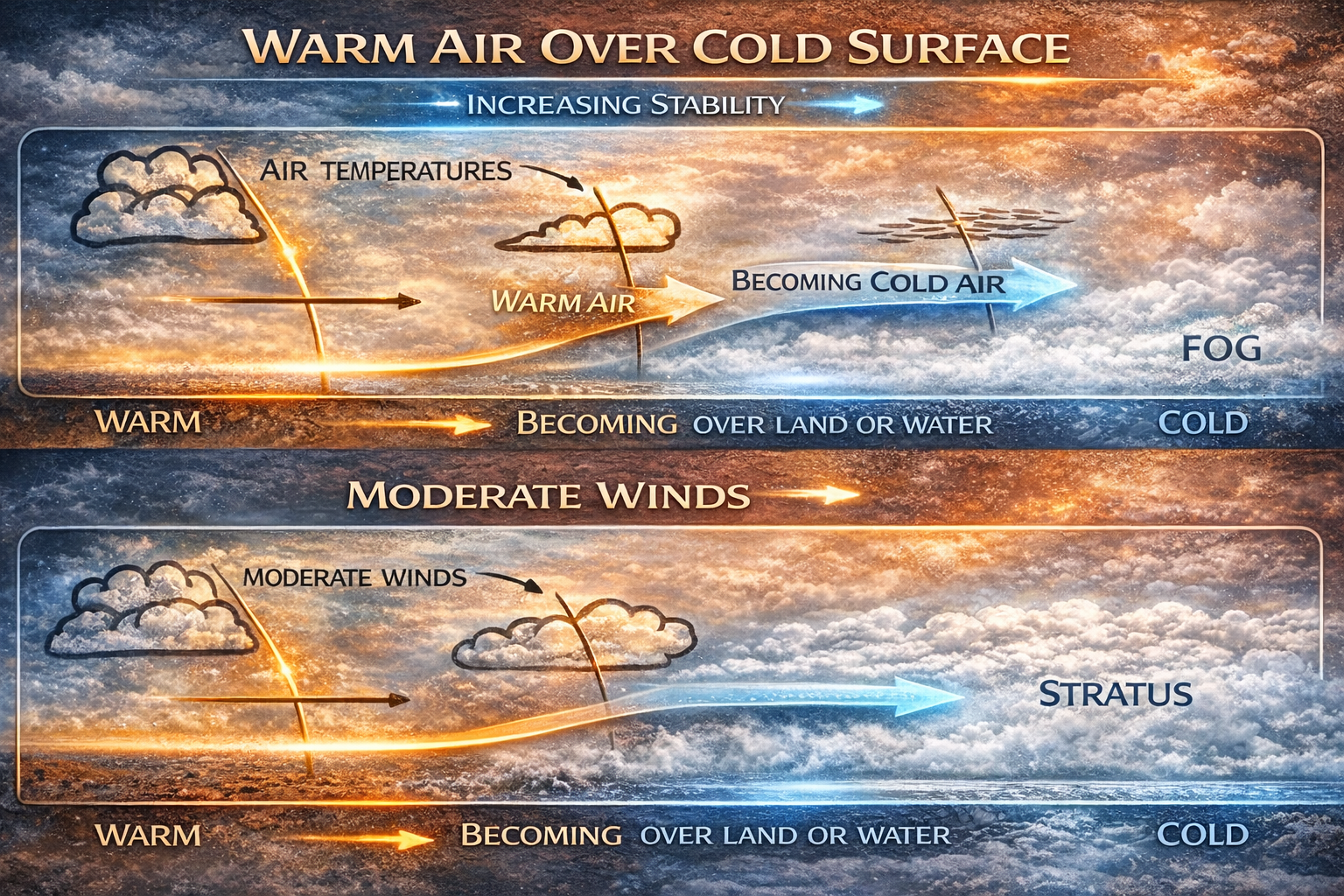
Warm air over a cold surface becomes more stable, often producing fog or low stratus clouds. Cold air over a warm surface becomes unstable, leading to vertical motion, convective clouds, and increased precipitation potential.
These stability changes provide important clues about cloud type, turbulence, and visibility.
Surface Moisture Influence
Moisture modification occurs through evaporation, condensation, and precipitation:
Air moving over warm water gains moisture and becomes less stable. Air moving over cold surfaces may lose moisture through condensation, increasing stability. Cold air passing over warm water often produces vigorous vertical motion and cloud development.
Large bodies of water play a significant role in altering both temperature and moisture content.

Topography and Terrain
Mountains significantly modify air masses:
On the windward side, air rises, cools, and loses moisture through precipitation. On the leeward side, descending air warms and dries, increasing stability.
This process explains rain shadows and sharp contrasts in weather across mountainous regions.

Trajectory and Airflow Pattern
The path an air mass follows also affects its stability:
Cyclonic trajectories decrease stability aloft due to rising motion and vorticity. Anticyclonic trajectories increase stability through subsidence and sinking air.
These effects influence cloud development and storm potential.
Age of the Air Mass
While age does not directly modify air, it determines how much modification has occurred. Newly formed air masses retain their original characteristics, while older air masses that stagnate over new regions lose many of their defining traits over time.
Stability: The Key to Weather Outcomes
The stability of an air mass determines the type of weather it produces:
Stable air favors widespread clouds, fog, and light precipitation. Unstable air supports turbulence, thunderstorms, and heavy precipitation.
Stability is influenced by both thermodynamic processes (heat and moisture changes) and mechanical processes (lifting, sinking, and turbulent mixing). These processes often occur simultaneously within a single air mass.
Why Air Mass Modification Matters
Every major weather event—from winter cold outbreaks to severe thunderstorms—depends on how air masses change as they move. By understanding air mass classification and modification, meteorologists can better anticipate cloud types, precipitation, visibility changes, and storm development.
Air masses may begin uniform, but it is their transformation that drives the dynamic weather we experience every day.