
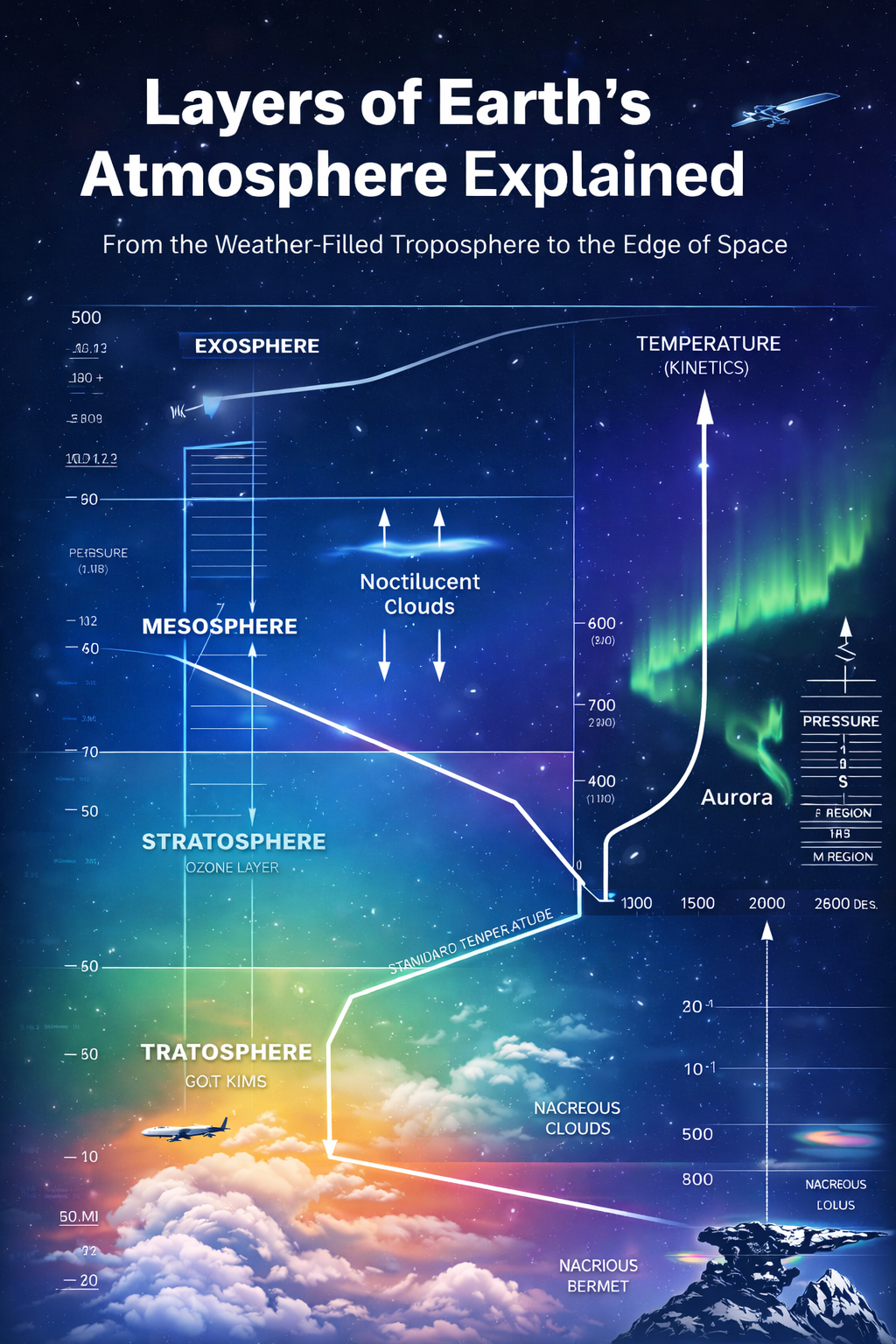
Earth’s atmosphere is not a single, uniform blanket of air. Instead, it is divided into distinct layers based on temperature behavior with height. Meteorologists classify the atmosphere from Earth’s surface upward into the troposphere, tropopause, stratosphere, stratopause, mesosphere, mesopause, thermosphere, and exosphere. Each layer plays a unique role in weather, climate, and how energy moves through the atmosphere.
Understanding these layers helps explain where weather forms, why temperatures change with altitude, and how Earth interacts with space.
The Troposphere: Where Weather Happens
The troposphere is the lowest layer of the atmosphere and extends directly upward from Earth’s surface. Its thickness varies by location:
- About 5.5 miles (9 km) over the poles
- Around 7.5 miles (12.5 km) in mid-latitudes
- Up to 11.5 miles (19 km) near the Equator
These values are averages and change with season, time of day, and weather patterns. The troposphere is typically thicker in summer than winter and thicker during the day than at night.
Almost all weather phenomena occur in the troposphere, including clouds, precipitation, storms, and most turbulence. In rare cases, strong thunderstorms or high-altitude cloud formations can extend into the tropopause or even the lower stratosphere.
Composition of the Troposphere
Dry air in the troposphere is made up of:
- 78% nitrogen
- 21% oxygen
- Nearly 1% argon
- About 0.03% carbon dioxide
- Trace gases such as helium, hydrogen, neon, and krypton
In addition, the troposphere contains variable amounts of water vapor, which is critical for cloud formation and precipitation. Warmer air can hold more water vapor than colder air at the same pressure.
Impurities and Condensation
The air also contains impurities like dust, salt particles, soot, and chemical aerosols. These particles are essential for weather processes because they act as condensation nuclei. Without them, water vapor would have difficulty condensing into cloud droplets. Particles that readily attract water vapor are known as hygroscopic nuclei.
Temperature Behavior
In the troposphere, temperature usually decreases with height, though temporary temperature inversions can occur in thin layers at various altitudes.
The Tropopause: A Transition Zone
The tropopause marks the boundary between the troposphere and the stratosphere. It is not a uniform or continuous layer around the globe. Instead, meteorologists generally recognize three overlapping tropopauses in each hemisphere:
- Subtropical
- Mid-latitude
- Subpolar
The tropopause is characterized by little or no change in temperature with increasing altitude, a sharp contrast to the troposphere below. While the gas composition remains similar to the troposphere, water vapor becomes extremely scarce at and above this level.
The Stratosphere: Home of the Ozone Layer
Above the tropopause lies the stratosphere, which extends to about 30 miles (48 km) above Earth’s surface.
In the lower stratosphere, temperature remains nearly constant with height. Higher up, however, temperature increases steadily with altitude. This warming occurs because of the presence of ozone, which absorbs incoming ultraviolet (UV) radiation from the Sun.
This temperature increase makes the stratosphere very stable, limiting vertical air motion and preventing most weather from developing in this layer.
The Stratopause: Another Turning Point
The stratopause marks the top of the stratosphere. At this boundary, the atmosphere experiences another temperature reversal, where temperature stops increasing and begins to decrease with height in the layer above.
The Mesosphere: The Coldest Layer
The mesosphere lies above the stratopause and is about 20 miles (32 km) thick. In this layer, temperature decreases with altitude, reaching some of the coldest temperatures found anywhere in Earth’s atmosphere.
The Mesopause: Transition to Extreme Heating
The mesopause is the thin boundary between the mesosphere and the thermosphere. Here, temperatures reach a minimum before beginning to increase again with height, signaling entry into the next major layer.
The Thermosphere: Rising Temperatures and Space Weather
The thermosphere extends upward from the mesopause toward space. It is the second major region where temperature increases with altitude, largely due to the absorption of high-energy solar radiation.
Despite extremely high temperatures, the air is so thin that it would feel cold to a human body. This layer is also associated with auroras and ionospheric activity, which affect radio communication and satellite systems.
The Exosphere: Earth’s Atmospheric Edge
The exosphere is the outermost layer of Earth’s atmosphere and represents the transition into space. In this region, gas atoms are so widely spaced that collisions are rare, and individual particles can follow independent orbits around Earth.
Why Atmospheric Layers Matter
These atmospheric layers are more than scientific labels—they explain:
- Why weather stays near the surface
- How solar radiation affects Earth
- Where turbulence, clouds, and storms can form
- How Earth gradually transitions into outer space
Understanding atmospheric structure is essential for weather forecasting, aviation, climate science, and satellite operations.
Explore more atmospheric science insights and weather explanations right here on our site.