
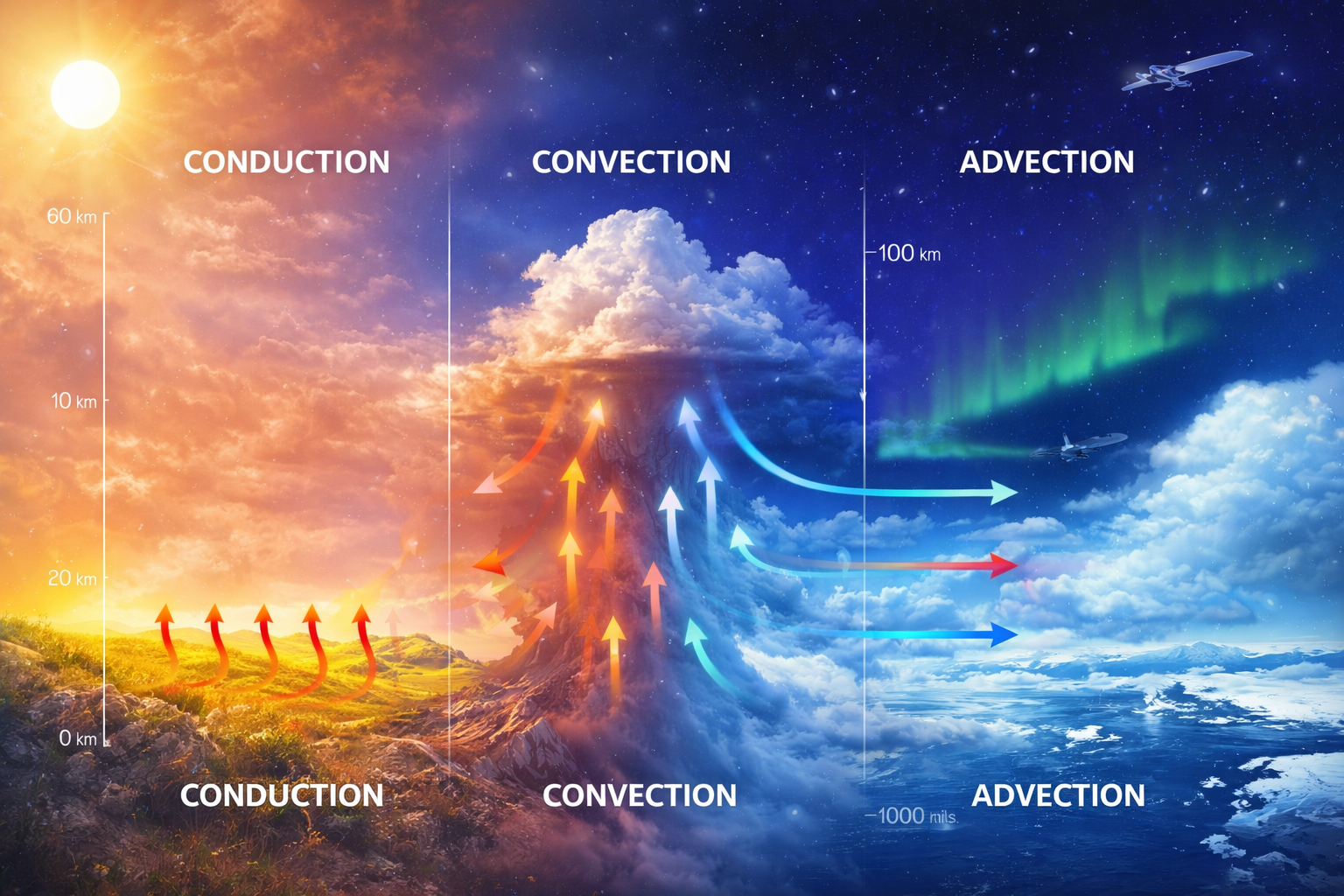
Earth’s atmosphere is in a constant state of motion because it is continually gaining and losing heat. The uneven distribution of solar energy across the planet drives wind, weather systems, and large-scale circulation. Air moves because heat moves—and understanding how heat is transferred is essential to understanding weather.
In meteorology, atmospheric motion and weather patterns are direct results of heat transfer and energy imbalance. Wind exists because some regions of Earth gain more heat than they lose, while others lose more than they gain. The atmosphere responds by redistributing that energy.
The Four Methods of Heat Transfer
Meteorologists recognize four primary methods of heat transfer:
Radiation Conduction Convection Advection
Radiation transfers heat between Earth and the atmosphere and within the atmosphere itself. Since radiation is often discussed separately, this article focuses on conduction, convection, and advection, which play critical roles in everyday weather processes.
Conduction: Surface-Based Heating and Cooling
Conduction is the transfer of heat from warmer matter to colder matter through direct contact. While conduction is not the dominant method of heating the atmosphere, it is important near Earth’s surface.
During the day, the Sun heats the ground. The air in direct contact with that warm surface gains heat through conduction. At night, the ground cools rapidly, and the air touching it loses heat in the same way. This process explains why temperatures near the surface change so quickly compared to higher altitudes.
Conduction mainly affects the lowest layer of the atmosphere, but its influence sets the stage for other heat transfer processes.
Convection: Vertical Heat Transport
Convection is the transfer of heat within a fluid—such as air—through vertical motion and mixing. A simple way to visualize convection is to imagine a pot of boiling water. Water at the bottom is heated, becomes less dense, and rises. Cooler, denser water sinks to replace it, creating continuous circulation.
In the atmosphere, convection works in much the same way. Warm, less dense air rises, while cooler, denser air sinks. As rising air cools and descending air warms, heat is redistributed vertically through the atmosphere.
Why Convection Matters in Weather
Atmospheric convection is responsible for:
Air turbulence Vertical mixing of heat and moisture The development of cumuliform clouds Showers and thunderstorms when sufficient moisture is present
Strong vertical convection is a key ingredient in severe weather. Without convection, storms would not form, and the atmosphere would remain largely stagnant.
Specific Heat: Why Land and Water Heat Differently
A critical concept tied to heat transfer is specific heat, which describes how much energy is required to raise the temperature of a substance.
Water has a specific heat of 1, meaning it takes 1 calorie to raise 1 gram of water by 1°C. Earth’s surface materials have an average specific heat of about 0.33, meaning land heats and cools roughly three times faster than water.
This difference explains why:
Temperatures over land change rapidly Temperatures over oceans and large lakes are more stable Coastal climates are milder than inland climates
Different land surfaces also have different specific heats. Dry sand and bare rock heat and cool fastest, while forested areas heat and cool more slowly. These differences can cause noticeable temperature contrasts between locations only a few miles apart, which plays an important role in weather patterns.
Advection: Horizontal Heat Transport
Advection is a specialized form of convection that refers specifically to the horizontal transport of heat and other atmospheric properties. In meteorology, convection describes vertical motion, while advection describes horizontal motion.
Advection occurs when air moves from one region to another—carrying its temperature and moisture characteristics with it. This process is essential to:
The exchange of heat between equatorial and polar regions The movement of warm and cold air masses Daily temperature changes caused by shifting winds
Advection transports more heat across the planet than any other physical motion of the atmosphere. It does so not only by moving warm or cold air, but also by moving water vapor, which releases heat when it condenses into clouds and precipitation.
Why Heat Transfer Drives Weather
Together, conduction, convection, and advection explain:
Why winds blow How storms form Why temperatures vary across regions How Earth balances energy between the tropics and the poles
Weather is the atmosphere’s response to uneven heating. Every breeze, cloud, and storm is evidence of heat being transferred from one place to another.
Understanding the Big Picture
Heat transfer is the engine of Earth’s weather system. Without it, the atmosphere would be motionless, and weather as we know it would not exist. By understanding how heat moves vertically and horizontally, meteorologists can better predict everything from daily temperature swings to large-scale circulation patterns.
Explore more weather science and meteorology fundamentals right here on our site.