
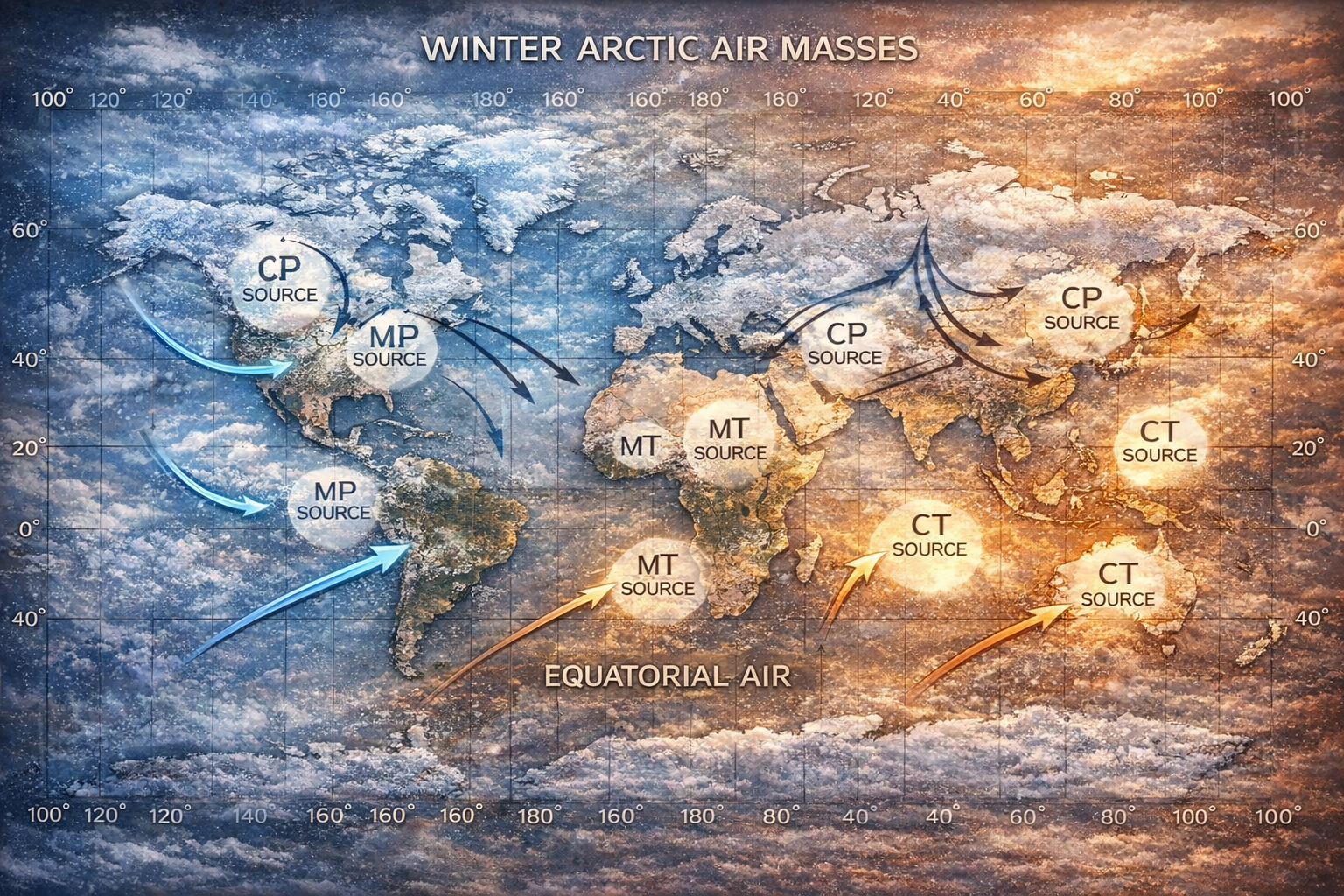
Weather across the globe is largely driven by the movement and interaction of air masses. These vast bodies of air carry specific temperature and moisture characteristics from their regions of origin and play a critical role in shaping daily weather and large-scale climate patterns. Understanding how air masses form and behave helps explain everything from winter cold outbreaks to tropical thunderstorms.
What Is an Air Mass?
An air mass is a large body of air—often spanning more than 1,000 miles—that has relatively uniform temperature and moisture properties throughout. These characteristics are acquired while the air stagnates over a region with consistent surface conditions, such as oceans, deserts, ice caps, or snow-covered land. Once formed, air masses can travel long distances, bringing their original properties into new regions.
Conditions Necessary for Air Mass Formation
For an air mass to develop, two primary conditions must exist:
A uniform surface The surface beneath the air—whether land, water, or ice—must have relatively consistent temperature and moisture characteristics. Weak pressure gradients and divergence aloft Slow-moving or stagnant air allows time for the air mass to fully adjust to the surface below, producing a homogeneous body of air.
Several atmospheric processes work together to establish equilibrium between the surface and the air, including:
Turbulent and convective heat transfer Radiational cooling Evaporation and condensation processes.
Among these, turbulent and convective mixing is the fastest and most effective mechanism, while radiation is the slowest. Moist regions, such as the tropics, form air masses quickly, whereas dry polar regions form them more slowly due to radiational heat loss.

The Role of Atmospheric Circulation
Not all circulation patterns favor air mass formation. The most favorable environments are anticyclones, or high-pressure systems. These systems feature sinking air, light winds, and divergent flow that spreads temperature and moisture characteristics over large areas.
In contrast:
Cyclonic systems (low pressure) generally prevent air mass formation due to stronger winds and instability. Belts of convergence usually inhibit air mass development, with notable exceptions over parts of the North Atlantic and North Pacific, which act as source regions for maritime polar air.
Major Air Mass Source Regions
Air mass source regions are typically large areas with uniform surface conditions and persistent pressure patterns. These regions give rise to several well-known air mass types:

Arctic (A) Air
Forms over polar ice fields and is extremely cold and dry. This air mass is very stable, especially near the surface.

Continental Polar (cP) Air
Originates over cold land areas such as Canada and Siberia. In winter, it is cold and dry; in summer, it becomes warmer but remains relatively dry.

Maritime Polar (mP) Air
Develops over cold ocean waters at high latitudes. This air is cool and moist and is a major contributor to cloudy, unsettled weather.

Continental Tropical (cT) Air
Forms over hot desert regions like the Sahara or the interior of Australia. It is hot, dry, and often associated with heat waves.

Maritime Tropical (mT) Air
Develops over warm tropical oceans. This air mass is warm and moisture-rich, frequently fueling heavy rainfall and thunderstorms.

Equatorial (E) Air
Found near the equator, this air mass is extremely warm and moist. Persistent convergence and strong solar heating lead to rising motion and frequent thunderstorms year-round.

Why Air Masses Matter
When air masses move away from their source regions, they interact with other air masses and are modified by terrain, surface conditions, and atmospheric circulation. These interactions often produce fronts, which are responsible for many of the clouds, precipitation, and storms seen on weather maps.
From winter cold snaps driven by continental polar air to severe storms fueled by maritime tropical air, air masses are the foundation of weather forecasting and atmospheric science.
Final Thoughts
Air masses are the building blocks of Earth’s weather systems. Their formation, movement, and interaction explain much of the variability we experience from day to day and season to season. By understanding where air masses come from and how they behave, meteorologists gain critical insight into forecasting weather and anticipating hazardous conditions.