
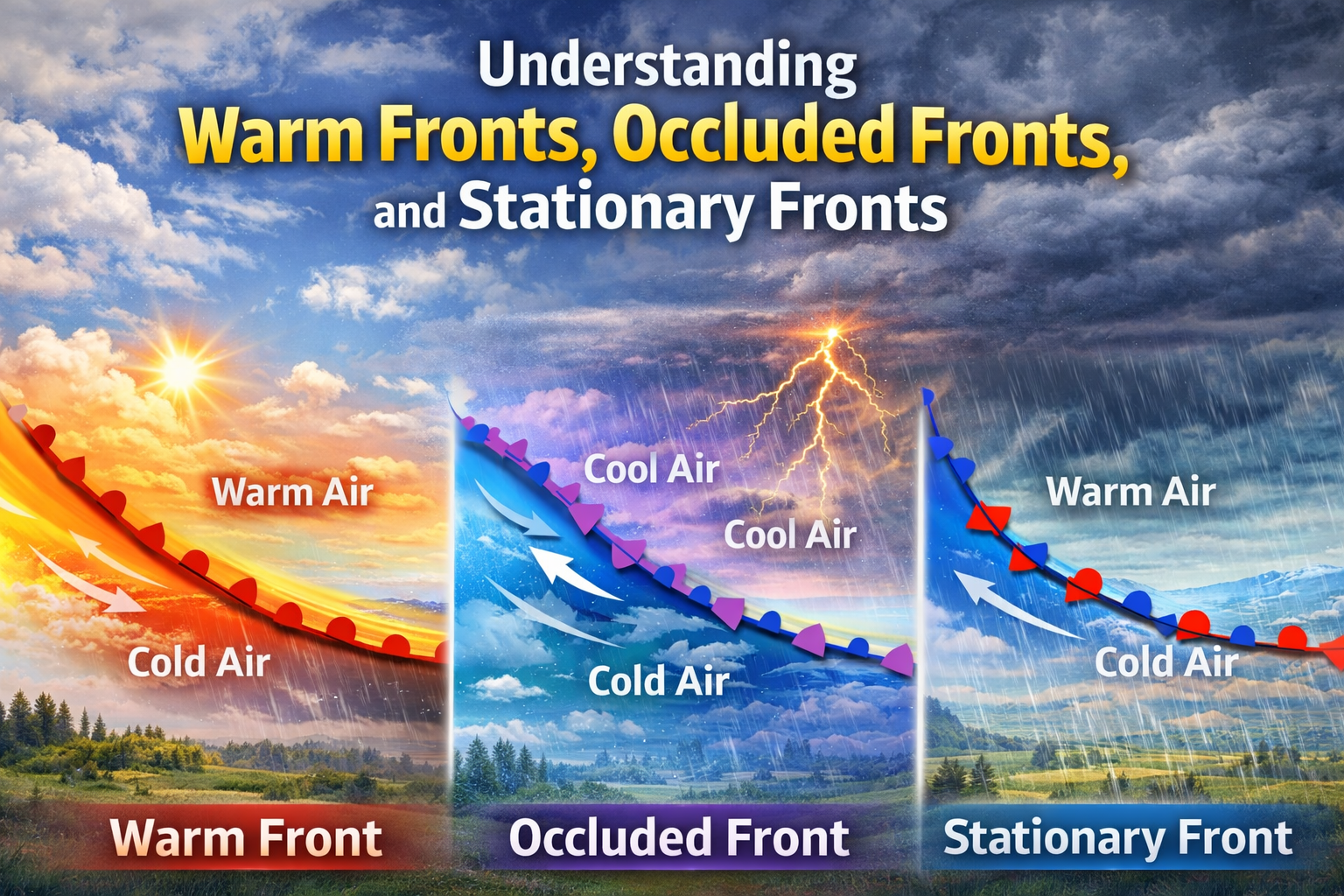
Weather fronts are boundaries between air masses with different temperatures and moisture levels. These fronts are responsible for many of the weather changes we experience, including precipitation, cloud formation, temperature shifts, and storm development. Understanding how warm fronts, occluded fronts, and stationary fronts behave helps meteorologists predict weather patterns more accurately.
Let’s break down each type of front and how it impacts everyday weather.
What Is a Weather Front?
A weather front forms when two different air masses meet. Each air mass carries unique characteristics such as temperature, humidity, and density. When they collide, they create atmospheric lifting, which can produce clouds, precipitation, and changing weather conditions.
There are several types of fronts, but warm fronts, occluded fronts, and stationary fronts each have distinct characteristics and weather impacts.
Warm Fronts: Gradual Weather Changes
A warm front occurs when a warm air mass moves toward and rises over a retreating cold air mass. Because warm air is less dense, it gradually slides upward over the cooler air.
Weather Associated with Warm Fronts
Warm fronts typically produce widespread and steady precipitation. As the warm air slowly lifts, layered clouds develop and precipitation begins well ahead of the front.
Common weather patterns with warm fronts include:
- Increasing cloud cover
- Light to moderate steady rain or snow
- Rising temperatures
- Increasing humidity
- Reduced visibility due to fog or mist
Warm fronts often bring long-lasting precipitation rather than sudden storms, making them easier to forecast but still capable of producing significant rainfall.
Occluded Fronts: Complex Storm Development
An occluded front forms when a cold front catches up to a warm front, forcing the warm air mass completely off the ground. This process creates complex weather patterns because multiple air masses interact at the same time.
Types of Occluded Fronts
There are two main types of occlusions:
Cold Occlusion
Occurs when the air behind the cold front is colder than the air ahead of the warm front. The colder air wedges underneath both air masses, forcing warm air upward.
Warm Occlusion
Occurs when the air ahead of the warm front is colder than the air behind the cold front. The cooler air lifts the less cold air, pushing warm air upward.
Weather Associated with Occluded Fronts
Occluded fronts are often associated with mature storm systems and can produce:
- Heavy precipitation
- Thunderstorms
- Strong winds
- Rapid weather changes
- Widespread cloud cover
These fronts often signal that a storm system is reaching its peak intensity.
Stationary Fronts: Lingering Weather Patterns
A stationary front occurs when two air masses meet but neither has enough force to push the other out of the way. As a result, the front remains nearly motionless for an extended period.
Weather Associated with Stationary Fronts
Because the boundary between air masses remains in place, weather conditions can persist for several days.
Stationary fronts often produce:
- Extended periods of rain or drizzle
- Cloudy skies
- Fog and reduced visibility
- Occasional thunderstorms
- Potential flooding if heavy rainfall persists
These fronts are especially important in forecasting prolonged weather events.
How These Fronts Impact Forecasting
Meteorologists closely monitor frontal systems because they play a major role in shaping regional and national weather patterns. By analyzing the movement and interaction of air masses, forecasters can predict:
- Precipitation timing and intensity
- Temperature changes
- Storm development
- Severe weather risks
- Duration of weather events
Understanding the behavior of warm, occluded, and stationary fronts allows forecasters to provide more accurate and timely weather warnings.
Why Weather Fronts Matter to You
Weather fronts directly affect daily activities, travel plans, agriculture, and emergency preparedness. For example:
- Warm fronts can bring prolonged rain that affects outdoor events.
- Occluded fronts often produce severe weather conditions.
- Stationary fronts can lead to flooding from long-lasting rainfall.
Recognizing the signs of approaching fronts helps individuals prepare for changing weather conditions.
Final Thoughts
Warm fronts, occluded fronts, and stationary fronts are essential components of atmospheric weather systems. Each type of front influences cloud formation, precipitation patterns, and storm development in unique ways.
By studying how air masses interact along these boundaries, meteorologists gain valuable insight into the processes that drive weather changes. Whether it’s a gradual warm-up, a powerful storm system, or days of steady rain, weather fronts are often the hidden force behind it all.
Stay Informed and Weather Aware
Understanding weather systems helps you stay safe and prepared. Follow our weather education blog for more forecasting insights, storm explanations, and meteorology learning resources.